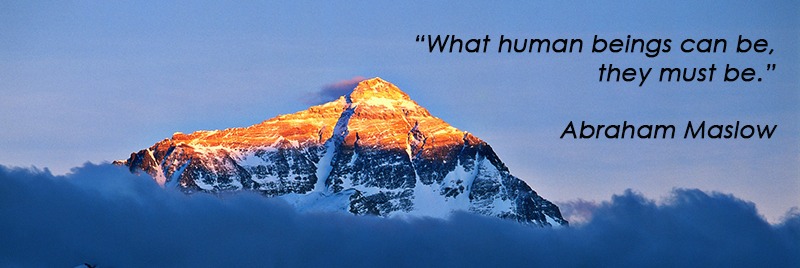
What one can be, one must be
“Musicians must make music, artists must paint, poets must write if they are to be ultimately at peace with themselves. What human beings can be, they must be. They must be true to their own nature. This need we may call self-actualization.”
Abraham Maslov
Most people, especially if they are into personal development, will have heard of Maslow’s Hierarchy of Needs.
In 1943 Maslow proposed that people are motivated to achieve a specific set of needs in their life and these needs can be grouped into an hierarchical system.
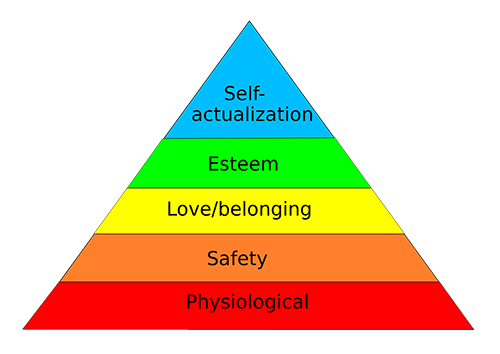
5. Self-Actualization needs – realizing personal potential, self-fulfillment, seeking personal growth and peak experiences.
4. Esteem needs – achievement, mastery, independence, status, dominance, prestige, self-respect, respect from others.
3. Love and belonging needs – friendship, intimacy, affection and love, – from work group, family, friends, romantic relationships.
2. Safety needs – protection from elements, security, order, law, stability, freedom from fear.
1. Biological and Physiological needs – air, food, drink, shelter, warmth, sex, sleep.
He stated that people have to meet the lowest level of needs before they can advance up the pyramid.
If you look at the needs listed for #1 it’s easy to understand the logic. You need air and water and food to survive even a few minutes or days. therefore, you need to address these needs immediately and constantly.
Then you would need to find safety and protection as listed in #2. And even #3, friendship, working relationships and belonging are essential to most peoples well-being.
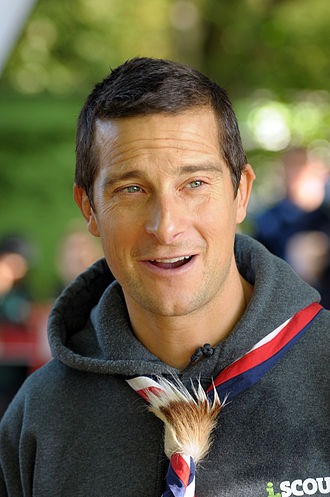
If you have ever watched “The Island”, with Bear Grylls you can immediately recognise the importance of Maslov’s laws and see them affecting people in real time.
Everyone wants to move up the ladder, and indeed everyone is capable of doing so. However, due to the modern world we live in and a shift in the way we reward people and perceive success many people never think to reach for Self-actualisation. Instead they see their self-esteem as the pinnacle of success such as how they are perceived by their peers and achievement of personal accolades.
Of course there are other outside influencing factors that can restrict someone from moving up the ladder including divorce and losing a job.
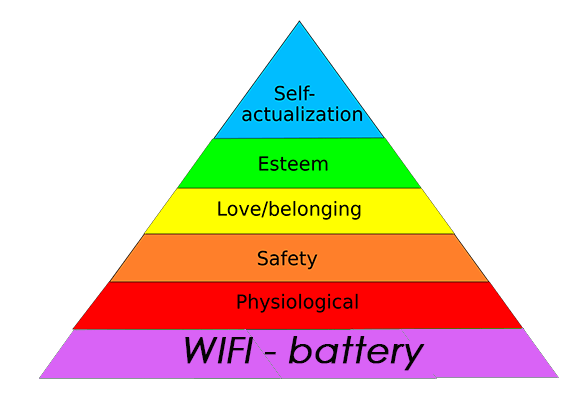
And although the diagram with the WIFI added on is meant as a little joke, it is scarily close to the truth for many people nowadays.
Personally, I prefer the model that Robert B. Dilts developed which goes like this and for me it is much easier to associate it to who we are and how we interact in our world-
- Spiritual
- Identity
- Beliefs and Values
- Capability
- Behavior
- Environment
Looking at this model it is easy to observe that some people mistakenly try to affect a higher level by changing something at a lower level. As an example, someone who isn’t happy with who they are will move house or change job thinking this is will resolve their issues. The change of scenery or new job feels great for a while, but soon the old issue surfaces again and they start to blame where they live, the job or people that surround them again.
Maybe worse still is when people don’t recognise the difference between capability and identity or maybe behaviour and spiritual levels. Calling someone an “idiot” for making a mistake is a capability issue yet is being linked to the child’s identity. Many parents will call their children a bad boy or girl if they do something naughty, which is a behaviour issue, yet doing so can affect them at a spiritual level, which I can’t imagine is the real intention of the parent.
Tony Robbins has what might be another version of Maslov’s law as follows-
The Six Human Needs
1. Certainty: assurance you can avoid pain and gain pleasure
2. Uncertainty/Variety: the need for the unknown, change, new stimuli
3. Significance: feeling unique, important, special or needed
4. Connection/Love: a strong feeling of closeness or union with someone or something
5. Growth: an expansion of capacity, capability or understanding
6. Contribution: a sense of service and focus on helping, giving to and supporting others
He explains that all behaviour is simply an attempt to meet these six needs.
He also states that we can create addiction if more than 3 needs are being met and conversely can replace addiction via these 6 needs as well.
In relationships this principle can explain why people jump from one relationship to another or commit adultery. When we first meet someone it is all knew and exciting and we are getting our uncertainty need met. Then after time it all becomes very certain (and if we are not careful mundane), so we then start to look for that bit of uncertainty again.
Maybe Osho sums up Maslov best with this-
“Man is not born perfect. He is born incomplete, he is born as a process. He is born on the way,
as a pilgrim. That is his agony and his ecstasy, too; agony because he cannot rest, he has to go
ahead, he has always to go ahead. He has to seek and search and explore. He has to become,
because his being arises only through becoming. Becoming is his being. He can only be if he
is on the move. Evolution is intrinsic to man’s nature, evolution is his very soul. And those
who take themselves for granted remain unfulfilled. Those who think they are born complete
remain unevolved. Then the seed remains the seed. It never becomes a tree and never knows
the joys of spring and the sunshine and the rain, and the ecstasy of bursting into millions of
flowers. That explosion is the fulfilment, that explosion is what existence is all about—exploding
into millions of flowers. When the potential becomes the actual, only then is man fulfilled.”