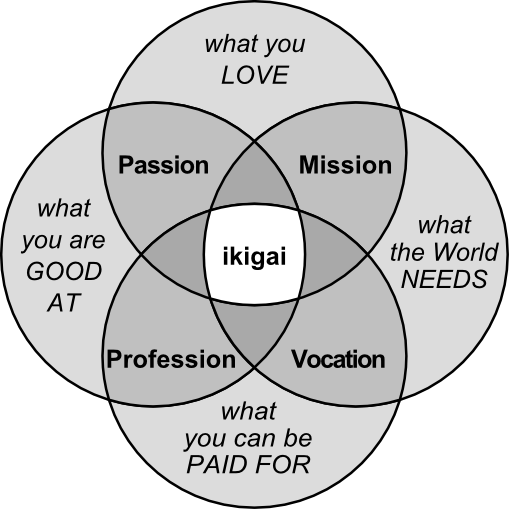
What is Ikigai (ee-key-guy) ?
Wikipedia: Ikigai (生き甲斐, lit. ’a reason for being’)
Ikigai is a centuries old Japanese philosophy and is believed to be the central reason that the people in Okinawa – an island to the south of mainland Japan – lead such long and fulfilled lives.
The philosophy, or maybe it is better described as a way of life, can be traced back to the Heian period, between 794 and 1185.
It has been translated as the realisation of what one expects and hopes for. It could be considered as the same or similar to your calling in life. The bbc website offers this There is no direct English translation, but it’s a term that embodies the idea of happiness in living. The same Google search also finds:
‘Iki’ in Japanese means ‘life,’ and ‘gai’ describes value or worth.
Victor Frankl’s soul moving book Man’s Search For Meaning possibly describes just how much one’s Ikigai can affect a person’s life.
The average age for women in Okinawa is 88.09 and men 81.91. In Scotland, where I live, it is 80.8 for females and 76.6 for men. That’s 8.2% more life for the women in Okinawa and for the men 6.5%.
Okinawan women live 8.2% longer than women from Scotland (the countries with the lowest numbers would shock you)
worldometer.info
It is often said that the Okinawans have an Ikigai, but they don’t have a word for retirement and that retiring isn’t something they do. Retirement isn’t a concept that they are familiar with because that’s the domain of their Ikigai. However, if you do a quick search, there are plenty of words for retirement in Japanese.
Retirement is a modern, Western concept
Germany became the first nation in the world to adopt an old-age social insurance program in 1889. It was designed by Germany’s Chancellor, Otto von Bismarck. Based on that, Germany’s Emperor, William the First, wrote to the German Parliament stating those who are disabled from work by age and invalidity have a well-grounded claim to care from the state. People retire three years earlier in Germany today at 67, however, they are debating about raising it to 70 again.
It wasn’t until the 1930’s that the first proposed plan for retirement was set in place in America. Created by Dr. Francis Townsend (1867-1960), an American physician, author, and political organiser, it was called the Townsend Plan and soon became very popular, even though it was criticised by economists of the time.
In the UK the Old Age Pensions Act was passed in August 1908 and the first payments were made on 1 January 1909.
Maybe this can help you find your Ikigai?
This diagram below seems to be a similar concept to an Ikigai and a good visual representation. It may help to you identify your Ikigai, or help you uncover an area of your work or hobby that can be improved on to possibly become an Ikigai.